Dryer vent cleaning in Church Farm, Whitewing and The Pecans
Custom and semi-custom building on large lots, which means longer runs, more of them, and a duct route nobody can predict from outside. $99 flat, roof terminations included.
Calls answered 7am to 8pm · same-day service usually available
Street address and a date and time that suits you is all we need.
The larger custom lots, around Rittenhouse and the older orchards
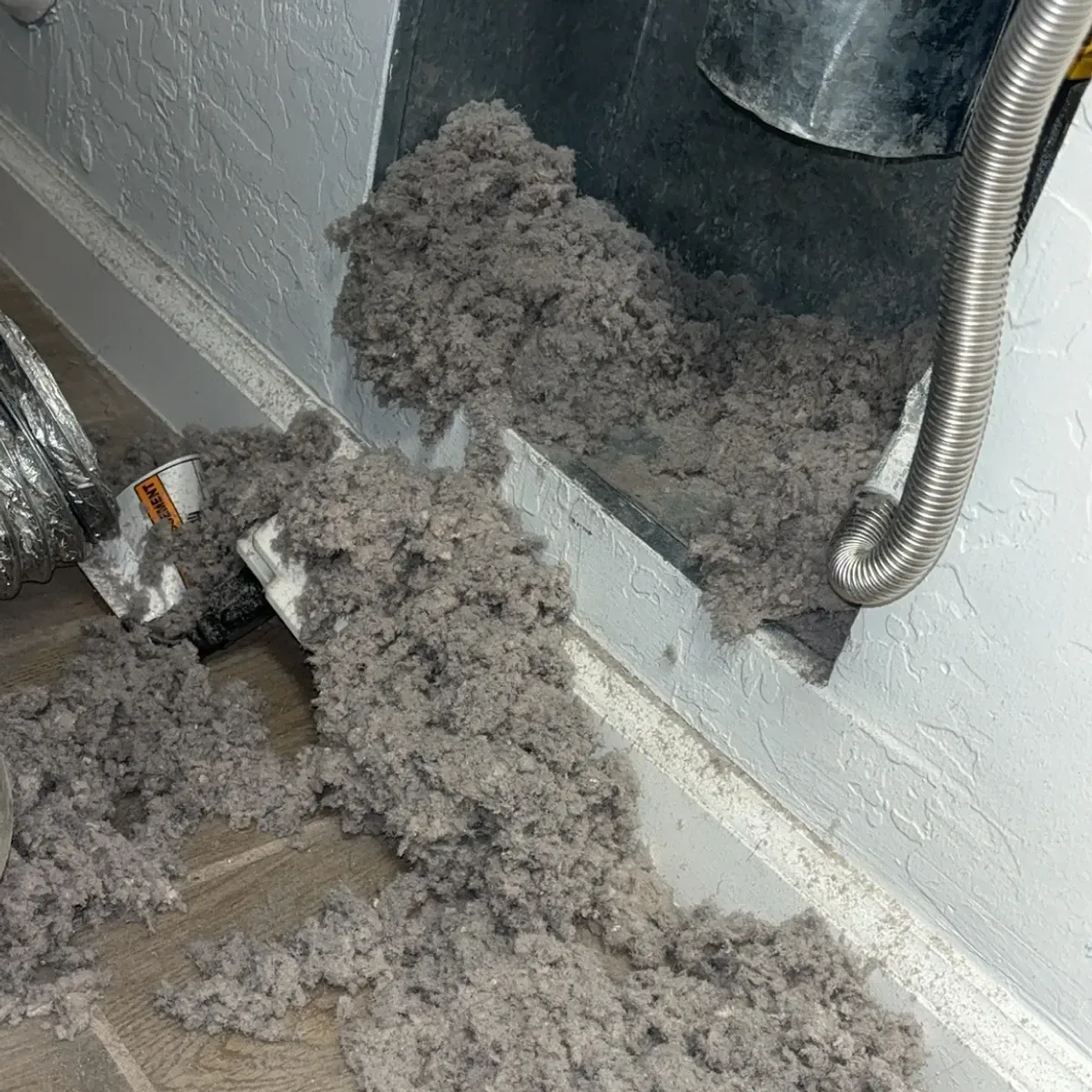
Custom building means the run went wherever it went
Most of what we clean sits in tract housing, where the same plan repeats down a street and experience genuinely tells you what to expect before you arrive. Custom lots are the opposite.
These houses were drawn individually, so your duct goes wherever it made sense to whoever laid it out, once, for your house, by somebody who is not around to ask. We have traced routes here that went horizontally through a floor structure before turning up, that exited on an elevation invisible from any approach, and that served a laundry room with no obvious relationship to either the roof or an outside wall.
So we work it out on site rather than guessing, and the price does not move because the house turned out to be complicated. Charging extra for that would amount to penalising people for their architecture.
More square footage, more distance, more bends
The arithmetic is simple and it is not in your favor. A larger house puts more distance between the laundry room and any exterior surface, and every extra bend the duct has to make costs you allowance.
Residential code permits 35 feet of equivalent length and deducts 5 feet for each ninety-degree bend, 2.5 for each forty-five. Three bends leaves roughly 20 feet of usable straight run. Four leaves 15.
A long custom run can be sitting on or past that line from the day it was installed. Nothing was done wrongly and nobody cut a corner, manufacturers and code officials both allow for it. What it means practically is that the run has almost no tolerance, so a modest deposit on the pipe wall is the difference between an appliance that works and one that does not.
Second laundry rooms and casitas
Worth raising because it comes up constantly on these properties and people forget about it entirely.
A lot of these homes have more than one dryer. A main laundry room, plus a second machine in a casita, a guest wing, a pool house or a garage. The second one gets used less, which is exactly why nobody thinks about it, and it has frequently never been serviced in the life of the house.
It is also usually the one with the strangest duct route, because it was added to a floor plan rather than designed into it from the start.
Each vent is $99. If you have two or three on the property we do them in the same visit, which saves everybody time, and we will tell you honestly if one of them did not need doing.
Source: National Fire Protection Association, Home Fires Involving Clothes Dryers and Washing Machines.
How the job runs here
- Establish the route. We follow where the duct actually goes, look at the cap or roof hood, and check the flexible length behind the appliance. On the newer builds out here the fault is very often in that flexible length rather than anywhere in the wall.
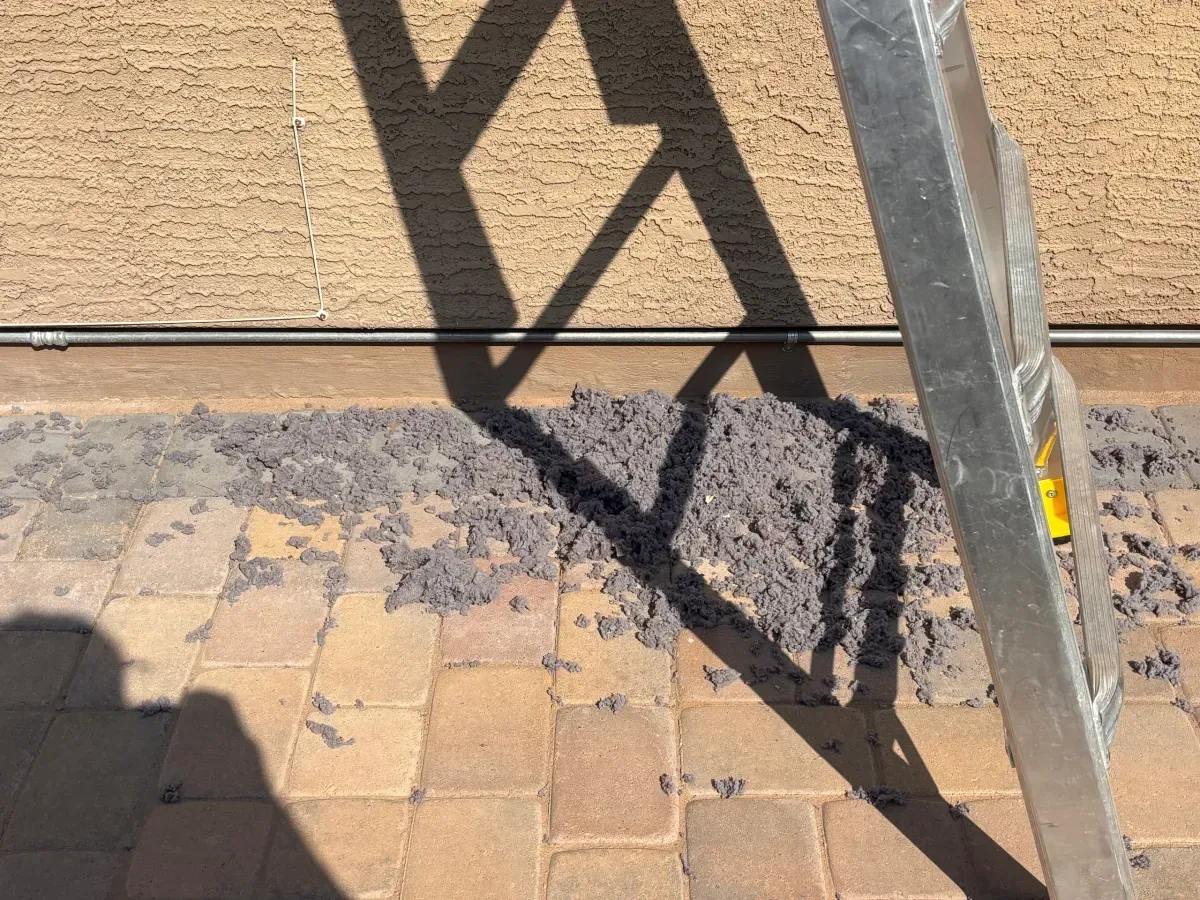
- Outside, with the machine running. The dryer stays powered the whole time we are at the termination so its own exhaust pushes what we loosen out and away, instead of allowing it to drift back into the run. Lint goes everywhere outside. Tidying that is part of the job, not an extra.
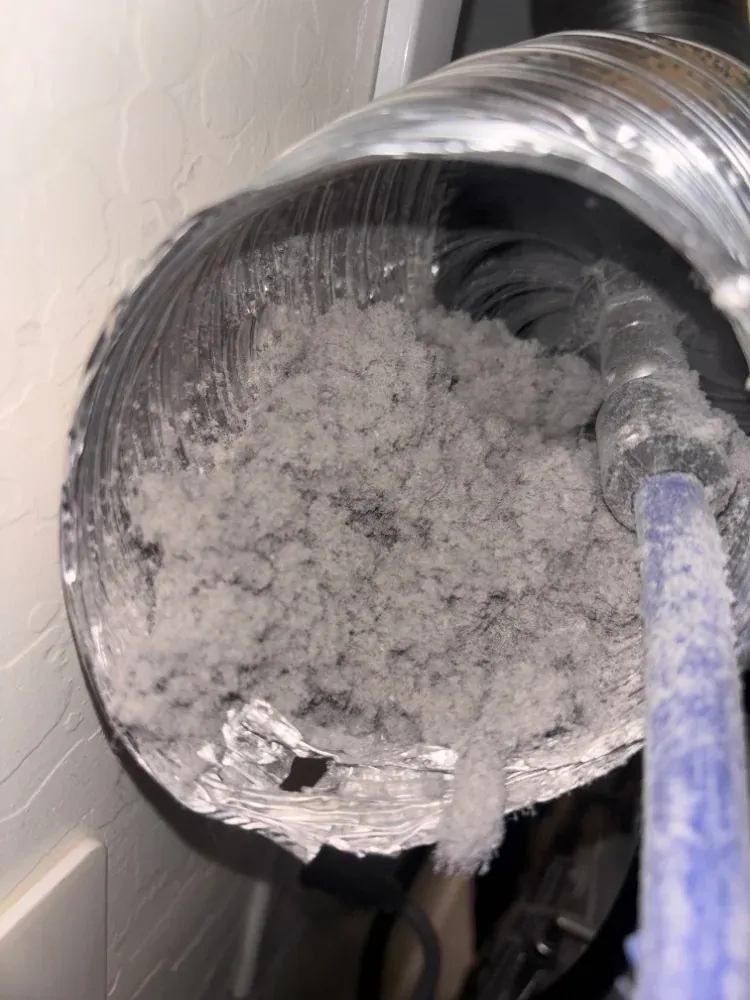
- Then from the inside. Power off, hose uncoupled, appliance pulled away from the wall. Brush into the vent from that end, material drawn back toward us and taken out with a vacuum rather than left to resettle.
- Two ends where the run justifies it. Long routes with several bends get worked from both directions, since a brush entering one side never reaches the far half properly. Short straight runs do not need it and we will tell you so.
- Reassembled, run, and shown to you. The appliance goes back where it belongs and gets started, and what we took out is left in front of you.
How often it needs doing
Ten months in an ordinary household. Put it in the calendar the way you would a filter change.
- Every 10 months for a typical Queen Creek home
- Every 4 to 6 months with a full house doing laundry most days, or where farm and construction dust is heavy
- Monthly on commercial machines
Most people out here treat a slow dryer as the moment to make the call. By that stage you are not coming up on the interval, you cleared it about a year ago. Slow drying is what eventually surfaces after months of restriction have already been going to work on the appliance.
And if your reasoning is that the house is new so the duct must be fine, that is worth reading about. New does not mean empty.
Questions from Church Farm, Whitewing and The Pecans homeowners
Is there a surcharge for coming out to Church Farm, Whitewing and The Pecans?
None. It is $99 flat everywhere in Queen Creek, and this area falls in 85142. No call-out charge, no pricing by zone, no extra for roof access. The town is compact enough that charging by location would just be billing you for our drive.
What happens when I ring?
We take the street address and a date and time that suits you, and you go in the diary. That is the entire process. You get the price on that call, $99 for a standard vent with roof access included, and most homes are fitted in within the same week. Same-day is often possible if you ring early. The phone is answered 7am to 8pm.
How often does it genuinely need doing?
Ten months in an ordinary household. Four to six where the house is full and laundry runs most days, or where farm and construction dust is heavy. Monthly on commercial machines. And if your trigger for ringing anybody is the dryer going slow, you passed the interval about a year ago.
My house is only a few years old. Surely it is fine?
Not necessarily, and this comes up more in Queen Creek than anywhere. Two things catch new homes. The corrugated foil hose behind the appliance gets folded flat when the machine is pushed back to shut the closet doors, which chokes the system three feet from the dryer. And ducts are installed early in a build and sit open while the house is finished around them, so construction debris is sometimes still sitting in the pipe at handover.
How do I tell whether mine needs it?
Two free checks. If the appliance has put up an error code, that is the duct about 95 percent of the time, and the machines out here are new enough to have that monitoring. Second, run it on the no-heat setting and feel the air at the outside termination. Strong steady flow means clear. Weak or nothing means restricted.
Do I have to move the dryer first?
No. We unplug it, uncouple the hose and draw it out ourselves, then put it back where it was and run it before leaving. Nobody should be hauling an appliance across a laundry floor on our account.
Elsewhere in Queen Creek
Ocotillo Heights and Cortina · Harvest and Barney Farms · Encanterra · Hastings Farms and the horse properties · Sossaman Estates and Queen Creek Station
Calls answered 7am to 8pm · same-day service usually available
$99 flat with roof access included. Call or text.