Dryer taking two cycles
In the large majority of cases this is a restriction rather than a dying machine. The two checks below cost nothing and tell you which, before any money changes hands.
Check one: has it put up a code?
Read this first, because it is the most dependable single indicator you have and hardly anybody mentions it.
A dryer showing a code is the duct roughly 95 percent of the time.
This matters more in Queen Creek than almost anywhere, because the appliances here are new enough to have the monitoring. A current control board watches cycle duration against exhaust temperature, and when restriction drives those two out of line with each other it posts a fault or ends the cycle early. Every brand gives it a different name. What sits underneath it never changes: the exhaust is not leaving the building.
The sequence that usually follows is an appliance technician, a service charge, and confirmation that the machine is in perfect order and the duct is packed. Check the duct before paying anybody to take the back off your dryer.
Older equipment cannot do this. It simply runs hot and takes two cycles until something burns out. In a town where most of the housing went up in the last fifteen years, you have the diagnostic. Use it.
Check two: the airflow test
Set the machine to air fluff, the no-heat option, and start it. Go outside to the termination and hold a hand near it.
Strong, steady flow. The duct is clear, cleaning it changes nothing, and the fault is inside the appliance. That is a repair technician's job, not ours.
Weak flow, or none. The duct is restricted, which is the entire thing we do, and it is $99.
Where the termination is on the roof and out of reach, do it from inside. Draw the machine out, uncouple the duct behind it, and run a single load with nothing attached. A load that dries normally that way points at the duct. Open a window first, because you are putting lint and moisture into the room.
Both checks together take about two minutes and cost nothing. Do them before ringing anybody, ourselves included.
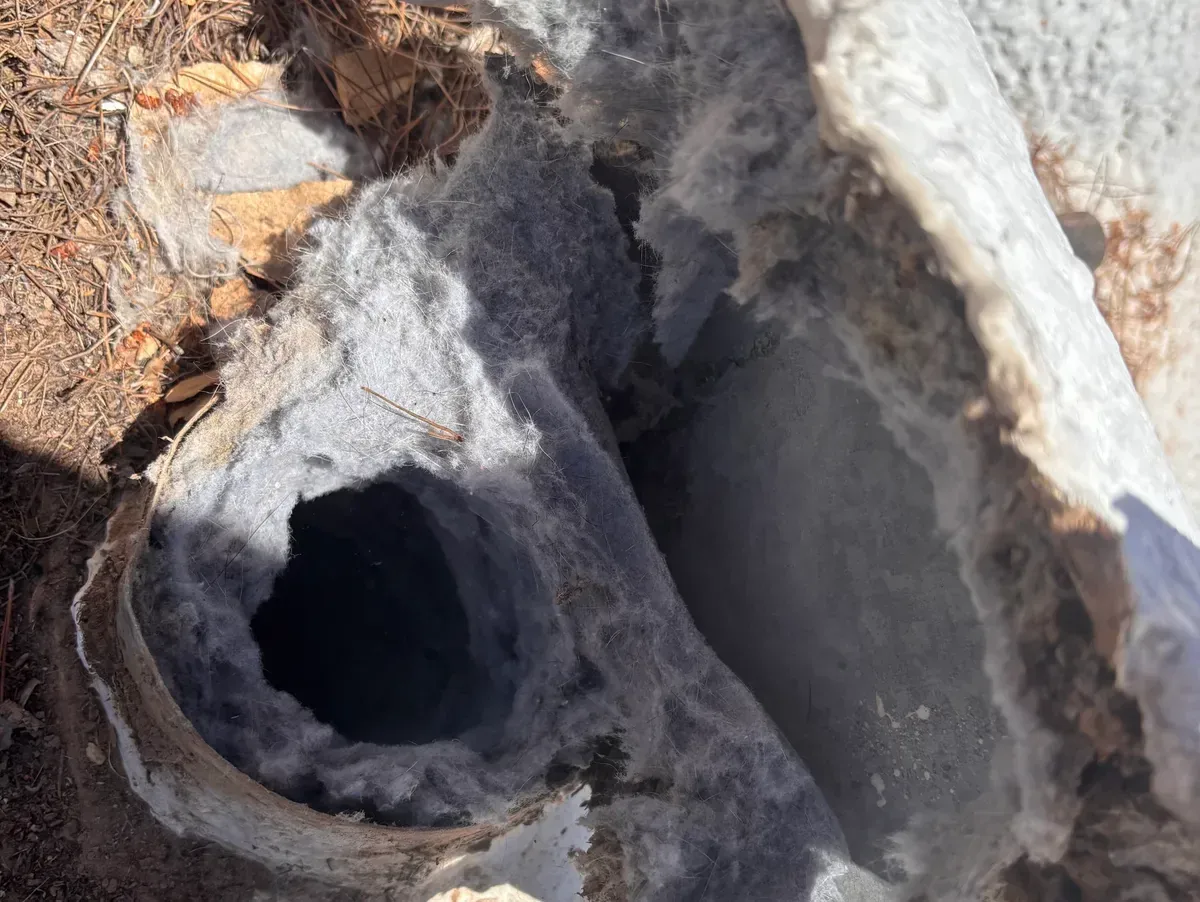
If it is the duct, what is in there?
A folded foil hose, if the house is newish
In Queen Creek this is the first thing to suspect, because most of the housing is young. The corrugated hose behind the appliance gets pressed flat when the machine is pushed back to shut the laundry closet doors, and it stays flat. The narrowest restriction in the system ends up three feet from the dryer, and the duct in the wall can be immaculate without helping. Full page on new builds.
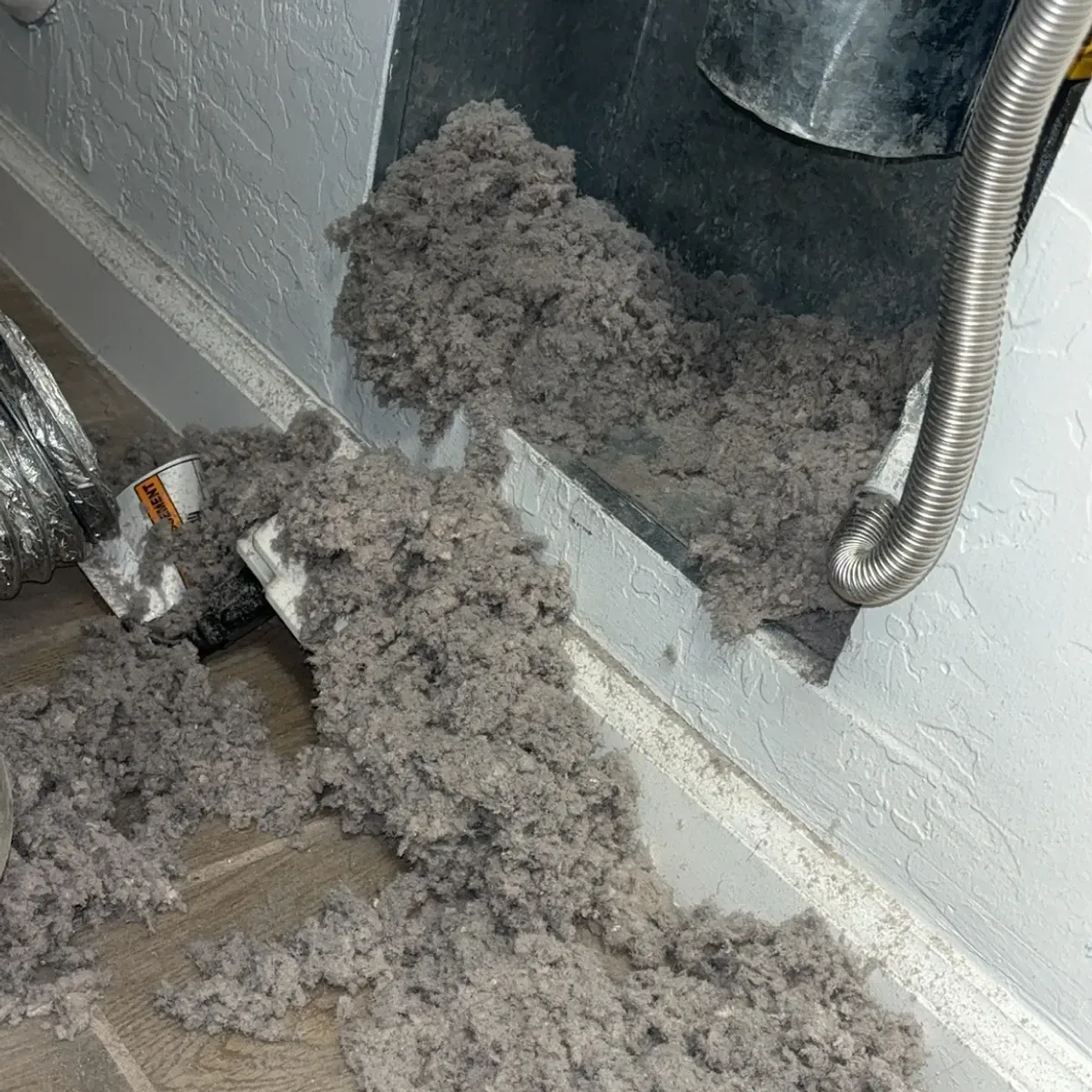
Construction debris, also if the house is newish
Ducts go in early in a build and sit open while trades work around them. Drywall dust, sawdust, the occasional offcut. There is no stage where anybody inspects that pipe before handover, so it is sometimes still there.
Compacted lint, if the house has a decade on it
The ordinary case, and it now applies to a good deal of Queen Creek. The decline is slow enough that a household adapts without registering it. The timescale depends on the run: a two-story in Sossaman Estates with thirty feet and three bends gets there in well under a decade with a full house.
Dust-bound deposits
Specific to this town. Soil from worked fields and from active construction binds into lint and produces something denser and more adherent than lint alone. It resists a blower entirely, which is why a cheap clean out here sometimes changes nothing at all.
Something nesting in the cap
Abrupt rather than gradual. Fine last month, hopeless now, and it is February to May. Full page.
The exterior flap seized shut
Less common here than in the older towns, simply because the hardware is younger, but it happens. Run the machine and watch the flap from outside. If it does not lift, that is the whole problem.
What it is doing to the appliance
Every dryer carries a thermal fuse meant to cut power before things overheat. A restriction has it intervening routinely while the heating element works well beyond its intended range, so the machine strains on every load.
What follows is a dryer that fails early and an owner convinced the manufacturer let them down. In most cases the appliance was perfectly good and the duct was never opened. Replacing it costs eight hundred to fifteen hundred. The clean costs $99.
Source: National Fire Protection Association, Home Fires Involving Clothes Dryers and Washing Machines.
We will tell you when it is not us
Worth stating plainly, because in a town with housing this young it comes up regularly.
If you ring and the duct turns out to be clear, we are not going to clean it anyway and invoice $99. You get told it is the hose, or the appliance, and charged accordingly or pointed elsewhere. That costs us the job and it remains the right call.
What we do about it
- Establish the route. We follow where the duct actually goes, look at the cap or roof hood, and check the flexible length behind the appliance. On the newer builds out here the fault is very often in that flexible length rather than anywhere in the wall.
- Outside, with the machine running. The dryer stays powered the whole time we are at the termination so its own exhaust pushes what we loosen out and away, instead of allowing it to drift back into the run. Lint goes everywhere outside. Tidying that is part of the job, not an extra.
- Then from the inside. Power off, hose uncoupled, appliance pulled away from the wall. Brush into the vent from that end, material drawn back toward us and taken out with a vacuum rather than left to resettle.
- Two ends where the run justifies it. Long routes with several bends get worked from both directions, since a brush entering one side never reaches the far half properly. Short straight runs do not need it and we will tell you so.
- Reassembled, run, and shown to you. The appliance goes back where it belongs and gets started, and what we took out is left in front of you.
How often it needs doing
Ten months in an ordinary household. Put it in the calendar the way you would a filter change.
- Every 10 months for a typical Queen Creek home
- Every 4 to 6 months with a full house doing laundry most days, or where farm and construction dust is heavy
- Monthly on commercial machines
Most people out here treat a slow dryer as the moment to make the call. By that stage you are not coming up on the interval, you cleared it about a year ago. Slow drying is what eventually surfaces after months of restriction have already been going to work on the appliance.
And if your reasoning is that the house is new so the duct must be fine, that is worth reading about. New does not mean empty.
Common questions
Why does it take two cycles?
Almost always a restriction in the duct. The machine makes hot damp air and it has nowhere to go, so the moisture stays in the drum. Less commonly it is a failed element or thermostat, and the checks on this page separate the two before you spend anything.
The dryer is showing a code. What does that mean?
Roughly 95 percent of the time it means the duct, and it matters more here because the appliances are new enough to have the monitoring. The control board tracks cycle length against exhaust temperature and faults out when restriction drives those out of line.
How do I tell which it is?
Run it on the no-heat setting and feel the air at the outside termination. Strong steady flow means the duct is clear and the fault is in the appliance. Weak or nothing means the duct. If the termination is on the roof, uncouple the duct behind the machine and run one load unconnected, with a window open.
My house is nearly new though.
That is exactly when people get caught. The duct in the wall is probably fine. The foil hose behind the appliance has very likely been folded flat since the day somebody first pushed the machine back to shut the closet doors, and there may be construction debris still in the run.
Can a restricted duct kill a dryer?
Yes. The thermal fuse intervenes repeatedly, the element runs outside its design range, and a machine that should give twelve to fifteen years goes at six or seven.
What if the checks say my duct is clear?
Then cleaning it will not help and we will say so rather than take the money. You want an appliance technician. We do not do appliance repair and nobody pays us for referrals.
Calls answered 7am to 8pm · same-day service usually available
$99 flat. If it turns out to be the appliance you get told that, not a bill for work that changed nothing.