New construction dryer vent cleaning in Queen Creek
A new house does not mean an empty duct. Two things catch nearly every new build out here, and neither of them is lint.
Calls answered 7am to 8pm · same-day service usually available
Street address and a date and time. $99 flat, roof access included.
Why this page exists at all
In most towns a dryer vent page is about accumulation over decades. Queen Creek is the youngest housing stock in the Valley, so that framing simply does not fit most of the homes here, and pretending otherwise would be dishonest.
What actually goes wrong in a new build is different, more specific, and easier to fix.
Problem one: what the builders left in the pipe
This surprises people and it should not, because it is a sequencing issue rather than a scandal.
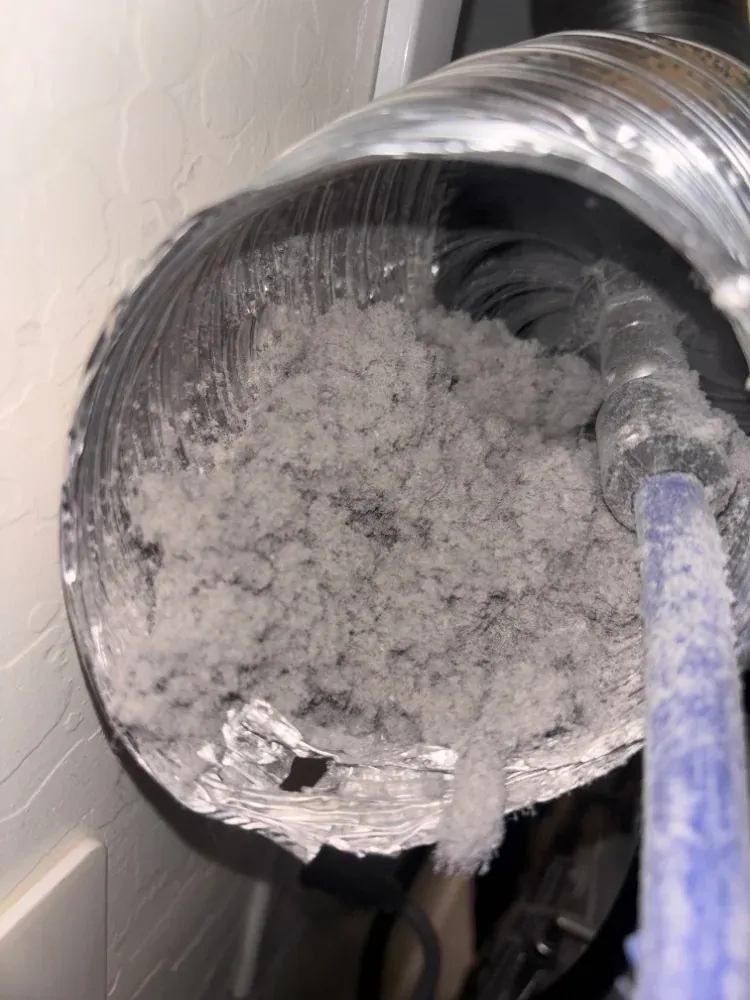
The duct goes into the house early, before the drywall. Then it sits there, open at both ends, while several trades work around it. Drywall dust in quantity. Sawdust. Occasionally an offcut or a scrap of packaging that found its way in.
There is no stage of a residential build where somebody is assigned to inspect that duct before handover. It gets capped, the appliance eventually gets connected, and whatever was in there stays in there.
Most of it is not dangerous on its own. What it does is give lint something to build on from day one, so a run that should have taken ten years to become a problem gets a head start it never needed.
Problem two: the hose gets crushed on day one
This is the more common of the two and it is almost universal in the newer phases.
Production builders fit corrugated foil hose behind the dryer, because it costs little and connects in seconds. Meanwhile the laundry closets in these plans are barely deeper than the appliances themselves, with bifold doors.
Getting those doors shut means pushing the machine back hard against the wall. That folds the foil almost flat, and it stays folded, because there is nothing structural about it to spring back.
So the narrowest restriction in your entire system ends up three feet from the machine, and the duct in the wall can be immaculate without making the slightest difference. When somebody rings us from a six-year-old house convinced their vent must be filthy, this is usually what we find instead.
Why foil is the wrong part here
Two failure modes, and a shallow closet triggers both at once. It collapses, with nothing to hold its shape. And every corrugation is a ledge, so lint catches on each ripple and accumulates faster than it would in smooth pipe carrying identical air.
Rigid transition duct fixes both. It is also closer to what the code has in mind, since the duct proper is meant to be smooth-walled rigid metal with the flexible section kept short rather than doing the work. That is our $98 hose upgrade, and in the new phases it is the extra we recommend most because it addresses the real problem.
Problem three, if the phase around you is still going up
Living inside an active build-out has an effect nobody mentions at the sales office.
Graded lots, haul roads and unpaved staging areas produce continuous fine dust, and it gets into everything, including the chamber under your lint screen and the duct beyond it. Combined with agricultural dust from the fields still being worked around this town, it is a meaningful load.
That is not cause for alarm. It is a reason to shorten the interval while the building continues, then relax it once the ground around you is finished and landscaped. Four to six months during, ten months after.
When to have it looked at
- Inside the first year of moving into a new build, mainly to clear the build debris and sort the hose
- While the builder warranty is still live, so anything that looks like a genuine installation fault can go back to them
- Every 4 to 6 months while a phase is still under construction nearby
- Every 10 months once the area is finished
- Immediately if the machine puts up an error code, which points at the duct about 95 percent of the time
What we will tell you
Here is the part that costs us money, and we do it anyway.
In housing under about eight years old, the duct in the wall is frequently in good order. When that is what we find, you get told. Replacing the hose and charging you for that beats taking $99 for a clean that changed nothing, and it is the difference between a customer once and a customer every ten months.
How we do it
- Establish the route. We follow where the duct actually goes, look at the cap or roof hood, and check the flexible length behind the appliance. On the newer builds out here the fault is very often in that flexible length rather than anywhere in the wall.
- Outside, with the machine running. The dryer stays powered the whole time we are at the termination so its own exhaust pushes what we loosen out and away, instead of allowing it to drift back into the run. Lint goes everywhere outside. Tidying that is part of the job, not an extra.
- Then from the inside. Power off, hose uncoupled, appliance pulled away from the wall. Brush into the vent from that end, material drawn back toward us and taken out with a vacuum rather than left to resettle.
- Two ends where the run justifies it. Long routes with several bends get worked from both directions, since a brush entering one side never reaches the far half properly. Short straight runs do not need it and we will tell you so.
- Reassembled, run, and shown to you. The appliance goes back where it belongs and gets started, and what we took out is left in front of you.
Source: National Fire Protection Association, Home Fires Involving Clothes Dryers and Washing Machines.
Questions from new build owners
Does a new house really need the dryer vent cleaned?
Often, yes, and for reasons that have nothing to do with lint. Ducts get installed early in a build and then sit open while the house is finished around them, so drywall dust, sawdust and offcuts end up in the pipe. Separately, the foil hose behind the appliance gets folded flat the first time somebody pushes the machine back to shut the closet doors.
How soon after moving in should I have it looked at?
Within the first year is sensible, mainly to clear anything left from the build and to deal with the hose. After that the normal ten-month interval applies, or four to six months if a phase is still going up around you.
Is construction debris in a duct actually common?
Common enough that we find it regularly. It is not negligence so much as sequencing. The duct goes in before the drywall and stays open through several trades, and there is no stage of a build where anyone is asked to inspect it before handover.
Will this void my builder warranty?
No. Cleaning a duct is maintenance, not modification. If we find something that looks like a genuine installation defect rather than ordinary debris, we will tell you and you can take it to the builder while the warranty is live, which is a good reason to look early rather than late.
What is wrong with the hose the builder fitted?
Nothing, until the appliance gets pushed against it. Corrugated foil has no structure, so it stays folded once something presses on it, and every ridge catches lint. Rigid transition duct has neither problem and is closer to what the code envisages.
Is the duct itself usually fine in a new home?
Usually yes, and we will say so. In housing under about eight years old the wall duct is frequently in good order and the problem sits in the first three feet. Charging $99 for work that changed nothing is not how we want to operate.
Calls answered 7am to 8pm · same-day service usually available
$99 flat. Phone answered 7am to 8pm, same-day often available.